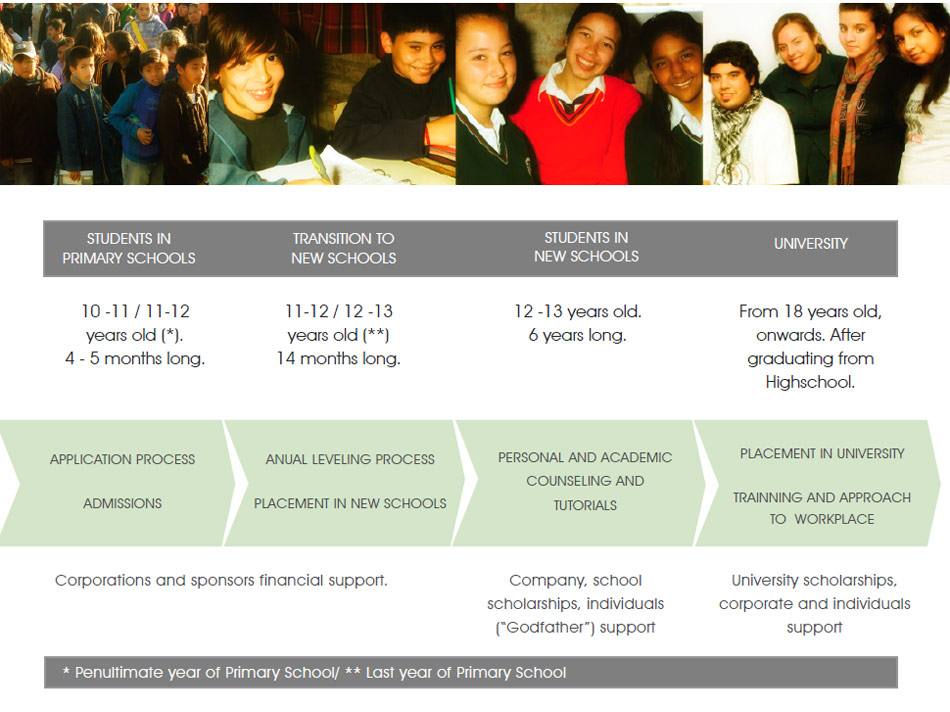
Recruitment:
Through community centers, schools and families, every year GERMINARE invites low-resource children currently attending the 5th grade and willing to improve their lives through education to enroll for the screening process.
Screening:
It is based on academic assessments, group activities, and individual and family interviews, as well as a psychological evaluation. We select children with no learning problems, who are willing to change their situation and can rely on the support and encouragement of their families. |
Annual Leveling Program:
This is a personal and academic development program which prepares children for their new schools. While still attending the 6th grade in their original school, children have classes on Saturdays for 14 months on such subjects as Language, Literature, Math, Social Sciences and English.
During this time, they also take part in a Personal Growth Workshop, with monthly meetings aimed at creating an individual and group environment for children to get ready for their new schools.
Schools and scholarships assignment:GERMINARE acts as a bridge linking families and schools, arranging scholarships for students to be able to obtain a high school degree. |
Integration:
During the first six months at the new school, children continue the leveling process by attending Saturday classes that aid their integration in this new stage.
Tuition (personal and academic support)
1. Personal follow-up: The academic team –made up of the Academic Director, the Area Coordinators, psychologists, educational psychologists, and teachers of different subjects for remedial classes– accompany each student along their personal and academic growth through:
- Monthly meetings with the Principal of the school they are attending
- Monthly follow-up meetings with each student
- Personal interviews with educational psychologists (psychopedagogical support)
- Remedial classes, if necessary.
2. Workshops and seminaries for students: Students take part in different workshops during high school according to their age, such as: “Study Planning”, for 12-year-old students (1st year); “Adolescence”, for 13 and 14-year-old students (2nd and 3rd year) and “Vocational Guidance”, for 16 and 17-year-old students (5th and 6th year).
3. English Language: Students are offered remedial English classes if necessary. Those who attend bilingual schools have additional classes as preparation for the following international exams: Cambridge First Certificate, IGCSEs (ICE) and ASs (AICE).
4. Encouragement and support for parents: Families play a fundamental role in the success of the program. The Foundation holds a very close bond with each family through individual and group meetings, and every year it organizes workshops to provide tools and strategies to help parents succeed in that role. The available workshops are: “How to support education”, “Adolescence 1 and 2” and “Guidance for College”.
5. Benefits: Students in this stage receive all the same benefits provided by schools to permanent students, such as: foreign language classes, camping trips, study trips, cultural outings, art workshops, choir sessions, IT lessons, sports tournaments, international exams, student exchanges, and vocational guidance. |